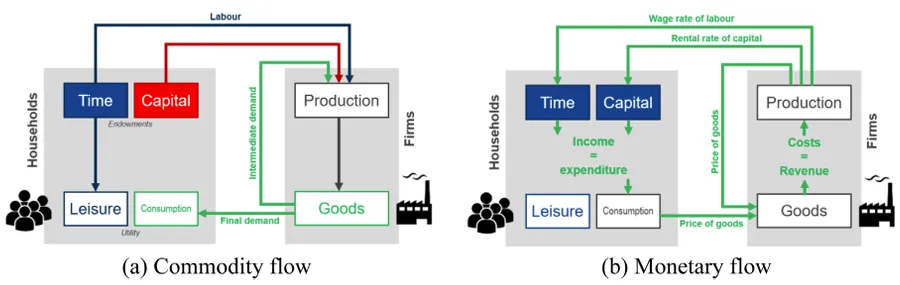
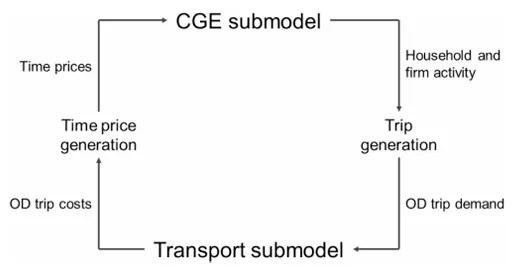
Previous studies have analysed the impacts of the introduction of autonomous vehicles on trans- port networks and estimated the safety, congestion, freight, parking and vehicle ownership im- pacts to social welfare and the economy. However, there appears to be a gap in the literature on the economic impacts of individuals allocating travel time in an autonomous vehicle to labour activities. This additional labour time could then have resulting impacts to productivity and the broader economy. This paper addresses this gap through the development of a novel microeco- nomic model incorporating time use in autonomous vehicles. The model captures an individual’s consumption behaviour, demand for leisure and supply of labour while accounting for the allo- cation of travel time to labour and leisure. It is an extension of existing microeconomic models of time use for two features: (1) travel utility, and (2) labour while travelling. This model is then implemented in an integrated computable general equilibrium and transport model for Sydney, Australia, and is tested to understand the order of magnitude of impacts. From this model, the increase in autonomous vehicle penetration rate and the resultant increases to household budget from travelling wages will result in a total welfare increase but with a decreasing rate, which are mainly due to congestion effects. Interestingly, the congestion effects also result in the production and value of time first increase, followed by a decrease, which are counter intuitive.





 10个月宝宝每天需要喝多少奶粉?

